
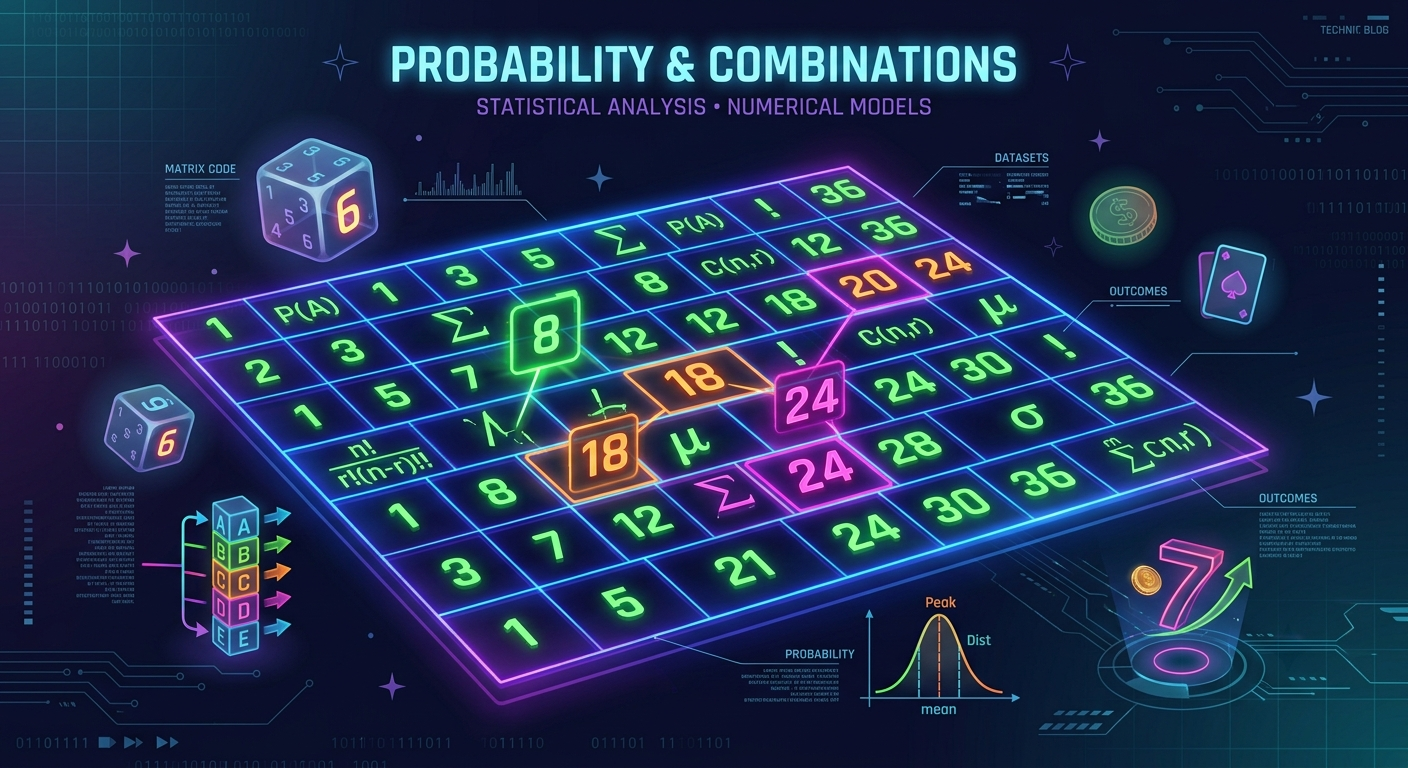
The human fascination with predicting numbers spans centuries, evolving from ancient cultural rituals into highly structured mathematical frameworks. In the modern digital era, this fascination has manifested as online numerical entertainment and lottery systems. While many participants view these games through the lens of pure luck or intuition, statisticians and data analysts look at them as vast playgrounds of probability, combinatorics, and market dynamics.
Understanding how these games function requires breaking down the core mathematics that govern number selection, along with the standard economic structures that allow these platforms to operate globally. By analyzing the intersection of statistical probability and transactional design, players and analysts alike can gain a clearer perspective on the mechanics of modern numerical platforms.
The Core Mathematics: Probability and Combinatorics
At the heart of every numerical game lies the branch of mathematics known as combinatorics. This field deals with counting, arrangement, and combination configurations within a defined set of elements. In a standard matrix-based game, a player must select a specific subset of numbers from a larger pool—for example, picking 4 digits out of a pool ranging from 0000 to 9999.
The probability of any single outcome is determined by strict formulas. In a basic lottery system where the order of numbers matters, the total number of unique permutations is fixed. For a 4-digit setup, there are exactly 10,000 possible combinations ($10^4$). Therefore, the mathematical probability of predicting the exact sequence is precisely 1 in 10,000, or 0.01%.
Because these odds are static, independent of past draws or future attempts, mathematical theory debunks the concept of “hot” or “cold” numbers. Every individual draw is an independent event, meaning the probability resets to its original state every single time the system runs.
Forecasting Systems: Algorithmic Modeling vs. Randomness
Over the years, a massive industry centered around forecasting systems has emerged. Analysts use complex software models to track historic winning numbers, searching for anomalies or deviations from standard uniform distributions.
Random Number Generators (RNG)
Modern digital platforms rely heavily on True Random Number Generators (TRNGs) or advanced Pseudo-Random Number Generators (PRNGs) to ensure absolute randomness. These systems use atmospheric noise or complex seed algorithms to generate sequences that cannot be predicted by external software. As a result, even the most sophisticated statistical forecasting models can only analyze theoretical probability distributions; they cannot bypass the inherent randomness programmed into the core server.
The Law of Large Numbers
Forecasting models often rely on the Law of Large Numbers, a theorem stating that as the number of trials increases, the actual ratio of outcomes will converge closer to the theoretical expected ratio. For instance, while a specific digit might appear three times in a row during a small sample of ten draws, across a sample size of one million draws, every digit from 0 to 9 will appear approximately 10% of the time.
Market Dynamics: Pricing, Payouts, and System Structures
Beyond pure mathematics, numerical entertainment systems must operate within defined economic boundaries. Every platform uses a specific baseline cost model to balance the ecosystem between sustainable operations and attractive user rewards.
In regional variations of these games, the cost per entry and the corresponding payout multipliers are closely regulated by standard market rates. When calculating potential returns relative to initial risk, players analyze structural variables such as the local standard harga toto or baseline ticket valuation metrics. These entry rates determine the overall liquidity of the prize pool. If the entry structure is optimized correctly, it allows the platform to maintain a stable house edge while ensuring that high-tier mathematical combinations yield mathematically proportional rewards.
Furthermore, these pricing mechanisms are directly tied to the risk-to-reward ratio across different tiers. Predicting a partial match (such as a 2-digit or 3-digit sequence) features much higher mathematical odds of winning, and consequently, the prize distribution shifts to reflect lower, more frequent payouts compared to the rare, high-value jackpot of a perfect 4-digit match.
Evaluating Platform Integrity via Structural Metrics
For analytical communities, checking the economic and mathematical integrity of a numerical platform is a standardized process. Because these platforms exist entirely in a digital environment, tracking transparency is critical.
When evaluating a system’s structure, analysts look for specific indicators of operational quality:
- Fixed Payout Ratios: Reliable systems clearly define their prize tiers and payout multipliers relative to the entry cost before any selection occurs.
- Audited RNG Certifications: Legitimate platforms subject their generation algorithms to third-party testing by independent software auditors to verify true mathematical randomness.
- Historical Archive Accessibility: Transparency is maintained when a platform provides a complete, unedited archive of historical draw data, allowing independent mathematicians to verify uniform distribution patterns over time.
Conclusion
Modern numerical entertainment games are far more than digital illustrations of chance; they are complex systems governed by rigid mathematical laws and precise economic structures. While forecasting models offer engaging ways to study data trends, the underlying random number mechanics ensure that probability remains absolute. By understanding the combination of combinatorics, probability matrices, and entry pricing structures, users can approach these platforms with a logical, analytical framework grounded in real-world mathematics.